Ad creative for e-commerce
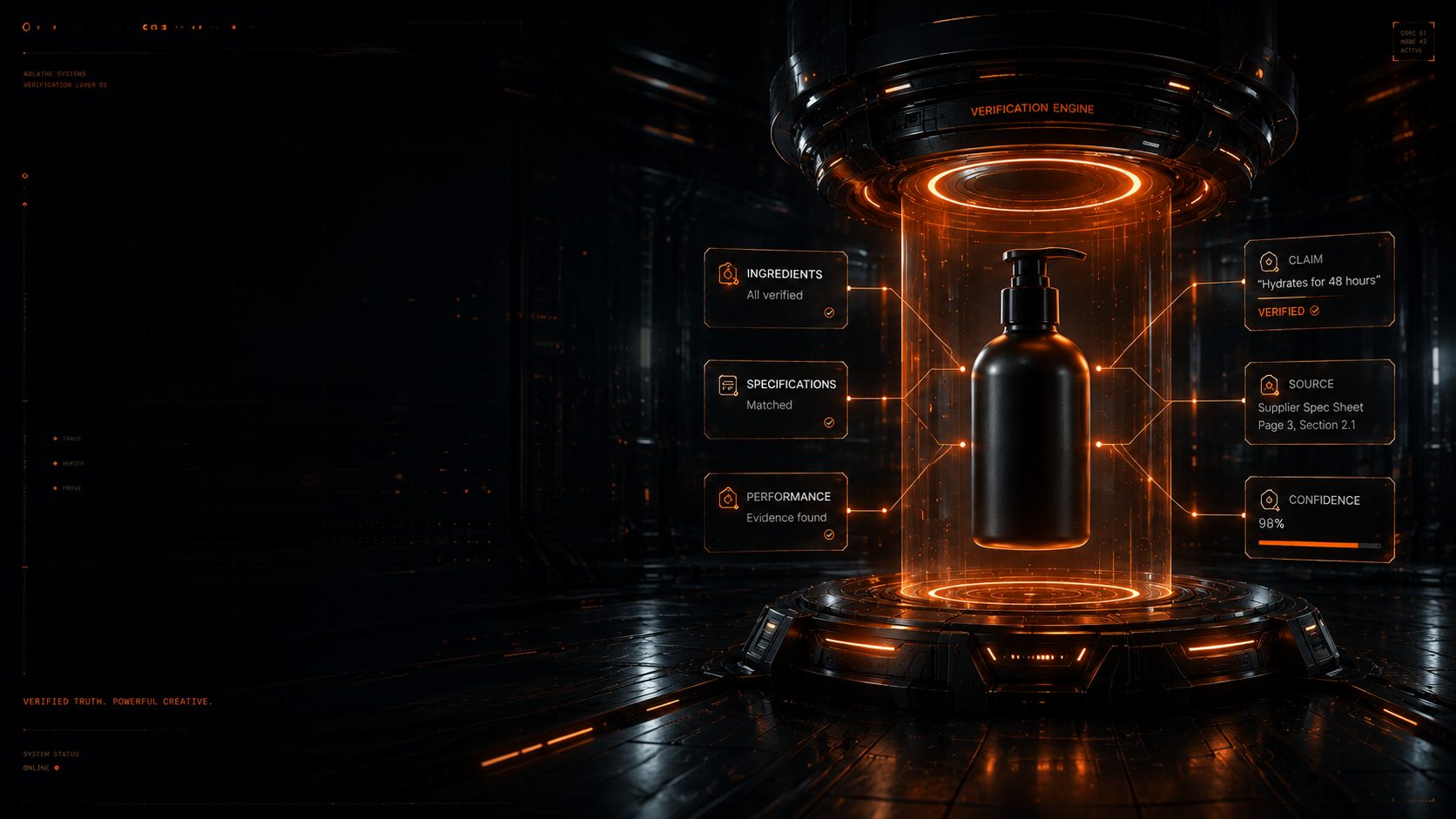
Drop in a product URL, its photos and the supplier spec sheet. Adlathe returns a complete ad kit — images, video, copy, voiceover, alt‑text, in every language you sell in. Every claim is traceable to a verified source. Anything it can't verify, it refuses to say.
No invented specifications. No hallucinated materials. No claims your supplier never made.
THE CHALLENGE
Ask a model for product copy and it will confidently produce a thread count, a battery life, or a material that appears nowhere in your data. It reads beautifully. It is also a claim you now have to defend.
So a person reads every generated ad against the spec sheet before it ships — which is exactly the manual work the tool was supposed to remove.
Advertising claims need substantiation. Ad platforms reject policy violations. Accessibility law requires meaningful alt‑text. None of that is optional, and none of it is fun.
THE PIPELINE
A product URL, photo uploads, and the supplier spec sheet as a PDF. The page is parsed, the document is read with OCR and layout analysis, and the photographs are examined by a multimodal model that identifies the object, its regions and its visible characteristics.
⚠ Merchant-uploaded images are treated as untrusted input and screened for instructions hidden inside the image itself.
Everything known about the product, as structured fields — each one tagged with where it came from: the spec sheet, the product page, the photograph, or the merchant directly.
This is the anchor. Nothing downstream may assert anything that isn't on this sheet.
Ad imagery generated from the real product photograph — backgrounds replaced, clutter removed, the product placed in a scene, all through masked editing that leaves the product itself untouched. Video ads generated and cut. Headlines written from what the model actually sees. Alt-text produced to accessibility guidelines rather than as an afterthought.
Ad copy grounded in the Truth Sheet. Angle and tone drawn from what real reviewers actually praise. Translated into every market you sell in, then spoken — voiceover generated in each language, in a consistent brand voice.
Every factual claim in the finished ad is checked back against the Truth Sheet. A claim with no source does not get softened or flagged for later — it is removed. The ad critiques its own output before a human ever sees it.
Visual policy is enforced in the same pass: watermarks present, prohibited symbols absent, brand usage rules respected, nothing that an ad platform will reject.
Nothing publishes itself. Every kit lands in front of a person with its sources attached, so approving it takes seconds instead of a spec-sheet cross-check.
What each generation cost, how long it took, which model produced it, and whether its grounding quality is drifting. If output quality falls, you find out from a chart rather than from a customer.
THE ANCHOR
A worked example. The middle column is the part that matters — it's why a generated ad can be defended rather than merely believed.
| Field | Value | Source | Usable in an ad? |
|---|---|---|---|
| Material | Full-grain leather | spec sheet, p.2 | yes |
| Dimensions | 420 × 300 × 120 mm | spec sheet, p.1 | yes |
| Colour | Tan | product photograph | yes |
| Hardware | Brass buckles | product photograph | yes |
| Capacity | 15" laptop | product page | yes |
| Waterproof | — | no source | refused |
| Handmade | — | no source | refused |
| Lifetime warranty | — | no source | refused |
Those last three are the ones a generative tool will happily write for you. Adlathe will not — not because it is cautious, but because there is no source to point at.
WHAT THE GATE CHECKS
Every factual statement mapped to a Truth Sheet field. Unsourced claims are removed, not flagged.
The output is reviewed against its own brief before a person is involved, and revised where it falls short.
Watermarks, prohibited symbols, brand usage rules, and anything an ad platform would reject.
Generated imagery screened for unsafe or disallowed content before it reaches your account.
Alt-text written to guidelines — descriptive, not a keyword dump, and not left empty.
Uploaded images checked for instructions embedded in the image, which is a live attack against systems that read pictures.
The interesting output isn't the ad. It's the list of claims it declined to make.
Open the Studio →